




Description
600 Pounds. Full Pendant Control. No Bending Required.
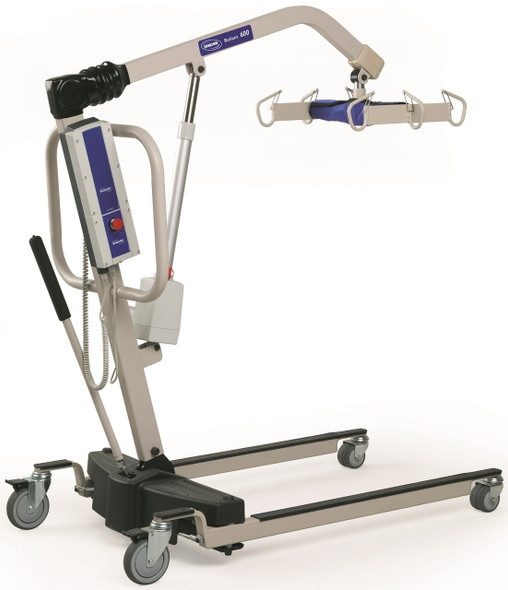
The Invacare Reliant RPL600-2 is the same lift as the RPL600-1 — same 600 lb capacity, same total pinch-point protection, same anti-entrapment system, same dual-battery setup, same 8-year expected service life — with one addition that matters most to caregivers who manage bariatric transfers alone or who shouldn’t be bending at floor level: a power base. On the RPL600-2, the hand pendant controls everything. Boom up. Boom down. Base open. Base closed. All from one pendant, no bending, no stepping, no reaching. Part of our full lineup of electric patient lifts.
Request Our Best Price Use the button above to request our special offer price
At a Glance
HCPCS Code E0635 — may be relevant for private insurance reimbursement. See insurance details in FAQs below.
Lovely customer service. Matthew took the time to help me with equipment questions I had in the past. I will always order from this company because they care and their prices are great too!
Why We Like This Lift
We like the RPL600-2 for the same reasons we like the RPL600-1 — Invacare’s full safety package at 600 lb capacity — and we like it specifically for caregivers who are managing bariatric transfers and shouldn’t be adding the physical burden of a manual base adjustment to every transfer. At 600 lbs, every unnecessary physical demand on the caregiver adds risk. The power base removes one of them. If the manual base works for your situation, the RPL600-1 is the same lift at a lower price.
Best for…
- Caregivers managing bariatric transfers who also have back pain, bad knees, or limited mobility
- Solo caregivers doing multiple 600 lb transfers daily who need every physical demand minimized
- Tight spaces — bathrooms, small bedrooms — where stepping on a pedal or reaching a shifter handle at floor level is impractical with a heavier patient
- Elderly caregivers managing bariatric care on their own
- High daily transfer volume where cumulative physical strain is a real concern
- Caregivers who have used the RPL600-1 and found the manual base the friction point in their routine
Feature Highlights
Power Base at 600 Pounds — Why It Matters More Here
On a manual base lift, opening and closing the legs requires the caregiver to use a foot pedal, lever, or shifter handle at floor level — bending, stepping, or reaching while also managing a 600 lb patient. On the RPL600-2, the hand pendant handles everything. One button opens the base legs wide; another closes them. No bending required. At higher patient weights, the physical demands on the caregiver are already greater — the power base removes one of the most repeated physical tasks from every transfer.
Total Pinch-Point Protection and Anti-Entrapment — Standard at Every Capacity
The RPL600-2 carries the full Invacare Reliant safety package regardless of capacity: total pinch-point protection on all moving parts, and an anti-entrapment system that stops the boom automatically if it meets any resistance while lowering. These are the same features on the RPL450-2 — Invacare built them into the entire Reliant platform, not just the lighter models.
28” to 68” Lifting Height — Floor Recovery to Elevated Surfaces
The RPL600-2 has a lifting height range of 28” to 68” at the sling hook-up — confirmed from the ADHME specs tab. The 28” minimum refers to the hook-up point on the lift, not how high off the floor the patient sits. Because the sling lays flat under the patient first and the straps do the lifting work, the lift supports floor-level fall recovery transfers. The hand pendant cord extends up to 8 feet, giving the caregiver full freedom of movement during a transfer.
Two 24V Batteries and Charging Station — Always Ready
One battery powers the lift while the other charges on the included wall-mounted charging station. With 150–250 lifts per charge under full bariatric load, two batteries means continuous operation through a demanding care day without waiting for a recharge.
8-Year Expected Service Life — Confirmed by Invacare
Section 1.2 of the Invacare owner’s manual states an expected service life of eight years when the lift is used daily and maintained per manufacturer instructions. For a bariatric lift used multiple times daily, that longevity commitment is built into the entire Reliant platform — including the RPL600-2.
See It in Action
Video Transcription
Introduction to Invacare Lifts and Slings
Practice transfers often so that you become proficient at the task before you try to lift a resident.
Practice lifts from bed to wheelchair or chair, from chair to bed, and floor to bed. Read and understand the owner-operator’s manual.
Safety is most important when performing lifts, and that includes your safety. Always use good body mechanics. Keep your center of gravity low and use your leg muscles. Separate your legs to establish a broad base of support. Keep your spine in natural alignment and never twist while lifting.
Always inspect the resident’s sling before using it. Check for wear, tears, and loose stitching. Bleached, torn, cut, frayed, or broken slings are unsafe and should not be used.
Invacare’s Jasmine and Reliant series full-body lifts are valuable tools for lifting and transferring non-ambulatory, bedridden, or obese patients. These battery-powered designs make it easier to assist any patient within the weight capacity of the equipment.
They can lift a person from a bed, a stretcher, a wheelchair, a commode, even the floor. Depending on the model, the lifts can handle patients that weigh up to 600 pounds.
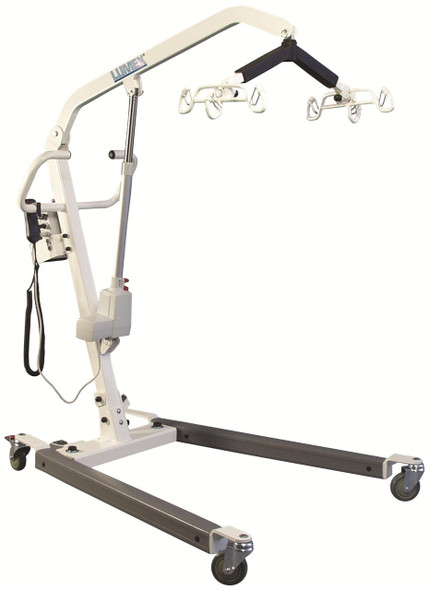
To get a better understanding of a Reliant or Jasmine lift, it’s good to know the parts. Basically, the lift is made of three assemblies: the base, the mast, and the boom.
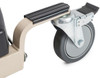
The base rides over the floor on these four low friction casters. The rear ones are lockable; this is a feature that comes in handy when you’re adjusting the sling for initial setup on the patient.
Next are the legs. There are two of them, and they’re adjustable. With the legs closed, the lift can be maneuvered more easily through doors, around furniture, and in tight hallways.
Jasmine lifts and some Reliant lifts have motorized legs that open and close with the touch of a button. Other Reliant lifts have manually operated legs. To make adjustments on these, you have to use the padded shift handle.
It’s pretty simple to open the legs: grab the shifter handle with one hand and the steering handle with the other, pull back on the shifter handle, and move the handle to the right. The legs will open. Make sure that the handle drops into this slot to lock the legs into place. To close the legs, just reverse the process.
We can’t emphasize enough the importance of making sure the legs are locked in the open position when lifting a patient. The lift is most stable when the legs are fully opened and locked; they must be fully open to ensure proper weight distribution and balance.
The next assembly is the mast. Here you’ll find these ergonomically designed push handles, a hand pendant which houses the operator’s controls, the battery, a control box, and the actuator which actually lifts the patient.
Attached to the mast is the boom. The boom is the lifting arm, and at the end of it is the swivel bar. The sling attaches to the swivel bar, and it’s padded for safety. The boom is operated by using the controls on the hand pendant. With the push of a button, you can gently raise or lower the boom. It’s very smooth and quiet.
Power for these lifts comes from a 24-volt battery. Each unit comes with two and a wall-mountable battery charger, so you can have one battery powering the lift while the other battery is on the charger. It takes about four hours to fully charge a battery. You can make about 200 lifts before a battery needs charging, and you’ll know when it needs to be recharged because this alarm will go off when the battery is low.
On both units, replacing the battery is easy. First, squeeze the handle here on top; this will unlock the battery from the mount. Pull the battery towards you to clear the bracket, then lift the battery up and towards you. Mount a fresh battery by sliding it along the bracket until it rests in the cradle, then push it away from you until you hear it click into place.
If the charger is plugged in, this green light will be on, and if you have properly installed the battery, this LED will light up to let you know that the battery is being charged. When the battery is fully charged, the LED will go out. It’s recommended that you leave the battery on the charger until you need to use it. The charger will trickle charge the battery to make sure that it’s always at full capacity, and daily charging will prolong the life of the batteries.
If for some reason you need to shut off all power to the lift, you can deactivate it by pushing in the stop button on the control box. To restore the power, rotate the stop button to the right.
It’s very unlikely, but if you ever need to lower the lift and the power unit fails, you can safely lower the boom by activating the emergency release. To activate the primary release on Reliant models, insert a pen or similar object into the hole on the control box labeled “emergency down.” This will cause the actuator to retract and slowly lower the boom. If that doesn’t work, you can use the secondary mechanical emergency release near the base of the actuator. Pull up on the emergency tab and push down on the boom at the same time; this will slowly lower the boom. There must be weight on the boom for this mechanical release to function.
Another safety feature built into all our battery-powered lifts is an anti-entrapment capability. An internal sensor will automatically stop the lift if it meets any kind of resistance while it’s lowering.
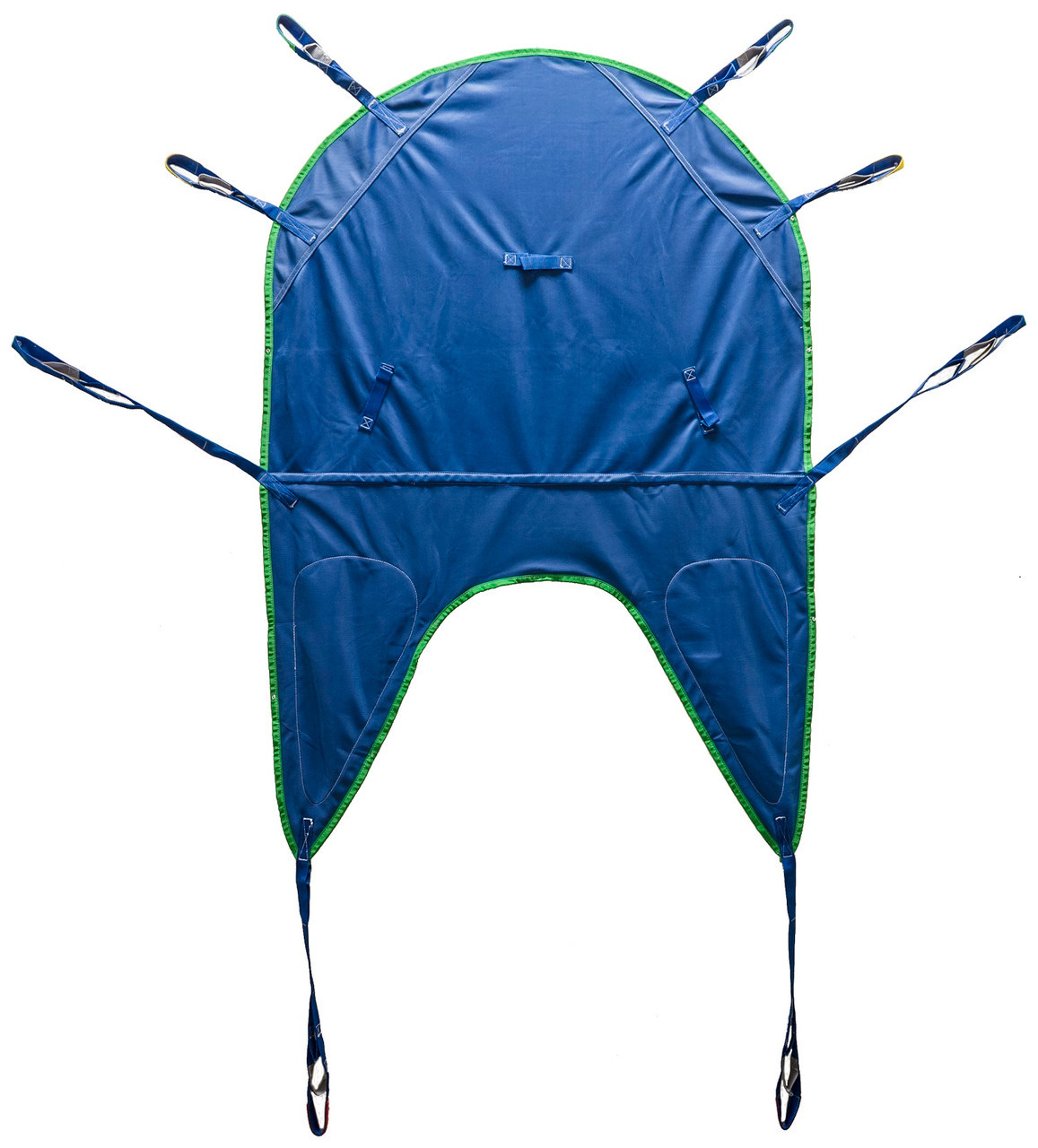
Invacare offers a wide selection of slings to meet most situations. They’re constructed of soft, durable mesh or solid fabric with padding for extra comfort.
Although one sling works for multiple residents, it’s recommended that each resident be issued their own individual sling to meet their specific size, weight, medical condition, and transfer requirements. Always check with a physician before selecting a sling.
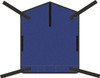
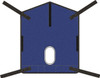
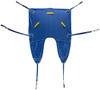
Generally, slings fall into one of three categories: full-body, divided leg, or universal toileting slings. The full-body and divided leg slings have built-in headrests for patients with limited stability, and the full-body sling has an optional commode opening.
Always inspect the sling before use. Check for wear, tears, and loose stitching. Bleached, torn, cut, frayed, or broken slings are unsafe and shouldn’t be used.
Most slings have reinforced grab straps sewn into the back to assist you in guiding your resident. Although Invacare lifts and slings have been designed so they can be safely operated by one caregiver, it’s recommended that two caregivers perform all resident transfers.
Before you attempt any kind of lift, make sure that you understand the resident’s limitations and their ability to assist the transfer. It’s a good idea to communicate with a resident throughout the process.
Your Options at Checkout
Sling (Choose One, or Order the Lift Only)
The RPL600-2 does not include a sling. You can purchase the lift without a sling if you already own compatible Invacare slings rated for your patient’s weight, or add one at checkout:
Which Sling Should You Buy?
| Patient need | Recommended sling type |
|---|---|
| General transfers | Full-body sling |
| Showering or bathing | Full-body mesh sling |
| Toileting transfers | Full-body commode sling |
| Easier wheelchair transfers | Divided-leg sling |
| Limited head or neck control | Divided-leg sling with head support |
Invacare Sling Sizing Guide
Weight is a helpful starting point, but sling selection should also consider the patient’s height, body shape, hip width, posture, and support needs. Always consult your healthcare provider if you are unsure which sling size is appropriate.
| Sling size | Approximate patient weight |
|---|---|
| Small | Up to 100 lbs |
| Medium | 100–200 lbs |
| Large | 200–300 lbs |
| X-Large | 300–500 lbs |
| XX-Large | 500–600 lbs |
Not every Invacare sling style is available in every size. Check the sling options in the add-to-cart section for the sizes available with your selected sling. If you’re not sure which size to choose, call or chat with us before ordering — proper fit is especially important at higher capacities. All slings must be Invacare-approved; third-party slings void the warranty.
Setup and Safety Notes
The RPL600-2 ships in one box weighing 141 lbs. Invacare recommends two people for unboxing and assembly. Read the owner’s manual completely before the first transfer.
- Do not attempt any transfer without approval from the patient’s physician, nurse, or medical assistant
- Base legs must be in the maximum open and locked position before lifting the patient
- Leave rear casters unlocked during all lifting procedures — locked casters prevent the lift from stabilizing itself as the patient is raised and could cause tipping
- Keep hands and fingers clear of all moving parts at all times — pinch points exist between the boom and hanger bar and at the base of the lift
- Check sling attachments every time the sling is removed and replaced before lifting
- The patient’s arms should be inside the sling straps during lifting
- Do not roll the lift over uneven surfaces while a patient is suspended — use the steering handle on the mast to push or pull
- Use only Invacare-approved slings rated for the patient’s weight — third-party slings void the warranty and create serious injury risk at this capacity
- Never exceed the 600 lb weight limit
- This lift is for transfer only — not for transporting a patient from one location to another while suspended
- If power fails while a patient is suspended, insert a pen into the “emergency down” hole on the control box; if that fails, pull up on the emergency tab near the base of the actuator and push down on the boom to lower safely
- Do not expose the lift to extreme temperatures (above 100°F or below 32°F) or high humidity before use
Invacare requires that all lifting procedures be observed by a trained team of experts first, then practiced with proper supervision before transferring a real patient. While one caregiver can operate this lift, Invacare strongly recommends two assistants for all transfers at 600 lb capacity. Consult your healthcare provider or physical therapist before establishing a lift routine at home.
Pair It With
- Additional Invacare patient lift slings — full body, divided leg, and commode-opening styles; confirm weight rating for your patient before ordering
- Bariatric-rated hospital bed — adjustable height simplifies positioning the lift; confirm weight rating matches your patient
- Bariatric commode chair — pairs naturally with the commode-opening sling for bathroom transfers; confirm weight rating matches your patient
This lift was built for exactly this situation — not adapted from something lighter. It handles your weight completely, moves slowly and smoothly, and I control everything from one pendant. I don’t have to bend or step or reach — which means I can keep my full attention on you throughout every transfer.
Frequently Asked Questions
Is this a Hoyer lift?
Hoyer is a brand name that has become a widely used term for any full-body electric patient lift — similar to how Kleenex is used for tissue. The Invacare Reliant RPL600-2 is an Invacare battery-powered electric patient lift that does everything most people mean when they say Hoyer lift, with full pendant control of both the boom and the base legs, at 600 lb capacity.
What is the difference between the RPL600-1 and the RPL600-2?
One difference: the base. The RPL600-1 has a manual base — the legs open and close using a padded shifter handle. The RPL600-2 has a power base — the legs open and close from the hand pendant with the press of a button. Every other feature is identical: same 600 lb capacity, same pinch-point protection, same anti-entrapment system, same dual batteries, same warranty, same 8-year service life. If the manual base works for your situation, the RPL600-1 is the more economical choice. If pendant control of the base matters — especially for a caregiver managing bariatric transfers who shouldn’t be bending at floor level — the RPL600-2 is the right lift.
Will insurance cover this lift?
Medicare covers manual hydraulic patient lifts as durable medical equipment, but not electric lifts. If you’re set on an electric lift, there’s a path worth knowing about: Medicare may reimburse you for what it would have paid toward a comparable manual lift, and you pay the difference. Any Medicare benefit requires the purchase to go through a Medicare-enrolled DMEPOS supplier — which ADHME is not. If maximizing your Medicare benefit is the priority, we’d recommend going that route instead.
Private insurance: Many private insurers cover electric patient lifts when prescribed as medically necessary by a physician. ADHME doesn’t bill insurance directly, but provides a detailed paid invoice with the HCPCS code that you can submit to your private insurer for reimbursement. Contact your insurer before ordering to confirm your coverage and any required documentation.
HSA and FSA: Patient lifts are generally eligible expenses under Health Savings Accounts and Flexible Spending Accounts. The paid invoice ADHME provides serves as your documentation for reimbursement.
Use HCPCS Code E0635 when submitting to your private insurer for reimbursement.
Owner’s Manual
For full assembly, sling attachment, and operating instructions: Invacare Reliant RPL600-2 Owner’s Manual
Why Buy From American Discount Home Medical Equipment?
We’ve been in the home medical equipment business for over 30 years — first in a brick-and-mortar store in San Jose, now online serving customers across the country. We don’t carry everything. We carry what we’d recommend to someone we know.
Every product ships free to the contiguous U.S. with no minimum, and we back our prices with a lowest-price guarantee. If you have questions about whether this lift is the right one for your situation, call us at 1-800-956-6616 or start a live chat. We know patient lifts, we know slings, and we’ll help you make a decision you feel confident about.
Financing is available through BreadPay — quick approval, payments starting as low as $33/month.
- Hand pendant moves boom height and base width
- Emergency stop and manual lowering device
- Includes two batteries and charger
- Accommodates 2, 4 or 6 point slings
- Low base height for under bed clearance
- Lifts up to 600 lbs.
Specifications
| Height at Sling Hookup: | 28" - 68" |
| Base Height (clearance): | 4.5" |
| Base Width: | Open: 41" Closed: 26.5" |
| Base Length: | 48" |
| Casters: | Front: 3" Rear: 5", locking |
| Product Weights: | Base w/ Casters: 58 lbs. Mast w/ Battery: 40 lbs. Boom w/ Hanger: 17 lbs. |
| Total Weight: | 115 lbs. |
| Shipping Weight: | 141 lbs. |
| Batteries (2): | 24V DC |
| Battery Charger: | Input: 100V - 240V AC Output: 29.5V DC |
| Charging Time: | Max. 6 hours |
| Lifts per Charge*: | 150 - 250* |
| Weight Capacity: | 600 lbs. |
| Warranty | |
| Lift: | 3 years |
| Pump/Electronics: | 1 year |
| Battery: | 6 months |
| *varies with lift range and load | |
Additional Information
_lowestprice: |
RPL6002 |
Weight Capacity: |
600 lbs. |
Special Features: |
Backup Battery |
Special Features: |
Power Base |