Bariatric Wheelchairs with 500 lbs Weight Capacity: Top Picks Reviewed

Table of Contents
- What makes a wheelchair bariatric?
- Which wheelchair specs matter most?
- Our bariatric wheelchair picks by use
- Best all-around 500 lb manual wheelchair and folding option: Everest & Jennings Traveler HD
- Best 500 lb manual wheelchair under $500: Proactive Titus
- Best extra-wide bariatric wheelchair: Drive Sentra EC Extra Wide
- Electric bariatric wheelchairs for 500 lb users
- Best caregiver-pushed option for users up to 450 lb: ProBasics Bariatric Steel Transport Chair
- Manual, power or transport: Which works for your day?
- How to measure for a bariatric wheelchair
- What does a bariatric wheelchair cost?
- What to check before ordering online
- Frequently asked questions
- Find a bariatric wheelchair that fits you and your home
A wheelchair can support 500 pounds and still be the wrong size for the person using it. It can also fit the person comfortably and be too wide for the bathroom door. Before comparing bariatric wheelchairs, write down three numbers: the user’s weight, the seat width they need, and the narrowest clear opening on their daily route. If the chair will travel by car, find out how much someone will actually have to lift.
What makes a wheelchair bariatric?
A bariatric wheelchair is a heavy-duty wheelchair built to support a higher user weight. Many also offer wider seats. The word bariatric on a listing gives you a category to shop in. The specifications for the exact model and seat configuration give you the capacity and dimensions you can use to make a decision.
How a 500 lb wheelchair differs from a standard model
Look for differences at the points that carry the load. The 500 lb Traveler HD uses a reinforced folding frame and dual cross braces. The Titus has a heavy-duty steel frame and offers wider, higher-capacity configurations within the same product family. Reinforced upholstery, heavy-duty caster assemblies and stronger wheel components are other features you may see. The trade-offs can include a heavier chair, a wider footprint and more effort for the user or caregiver to move it.
Who needs a 500 lb capacity?
A person whose weight exceeds the limit of a 450 lb chair needs a higher-rated model, whether the chair is for everyday mobility or a temporary need during recovery. Someone who weighs less may still choose a 500 lb model because its seat and transfer setup fit better. If the user weighs more than 500 lb, move up to a model rated for their weight. An occupational therapist, physical therapist or wheelchair seating specialist can help when transfers, posture, skin protection or self-propulsion are concerns.
Which wheelchair specs matter most?
Weight capacity and safety testing
Check the maximum user weight on the manufacturer’s spec sheet or in the owner’s manual for the exact model and options you are ordering. Wheelchair test standards cover separate properties such as stability, braking, strength and fatigue. A standard cited in a listing is useful when it applies to that specific chair and configuration. If the user is near the limit or uses mounted equipment or other accessories, ask the manufacturer how those loads are counted. See the FDA’s recognized standards for mechanical wheelchairs.
Seat width and depth
A seat that presses against the hips or thighs can make sitting uncomfortable. One that is too wide can make handrims harder to reach and leave the user without the side support they need. Check depth as well. The seat needs to support the thighs while leaving space behind the knees. Include the cushion and any positioning supports in the fitting discussion.
Steel or aluminum frame
Steel is common in high-capacity manual models and can add weight when it is time to lift the chair. Aluminum generally weighs less for a comparable component and resists rust, though the complete chair’s weight depends on its frame design and hardware. Compare the actual capacity, chair weight and warranty of the models on your list. Frame material alone cannot tell you how a particular chair will hold up.
Wheels, tires and stability
Large rear wheels with handrims allow self-propulsion. Smaller rear wheels on transport chairs are designed for an attendant to push. Larger front casters can roll over small surface changes more easily, while smaller casters can suit smooth indoor floors. Solid tires avoid flats. Air-filled tires can soften the ride but need pressure checks. Rear axle position and seat setup also affect maneuverability and tipping behavior. Use the manufacturer’s approved setup and have a specialist assess any changes.
Armrests, footrests and cushions
Desk-length arms may let the chair get closer to a table. Full-length arms provide more forearm support. Removable or flip-back arms can free up space for side transfers when the transfer setup calls for it. Swing-away footrests clear space in front of the chair. Elevating legrests change how the legs are supported and add to the chair’s length when extended. If the user needs a pressure-management cushion, include it when checking seat height, depth and armrest position.
Folding versus rigid frames
A folding frame reduces storage width and can make a manual chair easier to load. A rigid frame keeps its shape, and some models let you remove the wheels for transport. Either design can be suitable when the chair is rated for the user. If someone has to lift it, look for the weight of the heaviest piece and measure the vehicle opening before buying.
Our bariatric wheelchair picks by use
We compared the listed capacities, seat options, overall dimensions, portability and prices of wheelchairs in the American Discount Home Medical catalog. Capacity applies to the configuration specified below. Check the product page for current pricing and availability.
Best all-around 500 lb manual wheelchair and folding option: Everest & Jennings Traveler HD
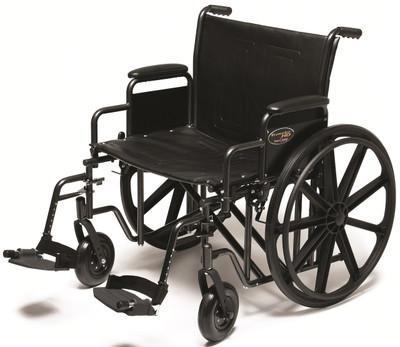
The Traveler HD is our first pick if you need a 500 lb manual chair and a 20-, 22-, or 24-inch seat. The reinforced folding frame, removable armrests and choice of swing-away footrests or elevating legrests let you choose a configuration for everyday use.
- Capacity and seat: 500 lb, with an 18-inch seat depth across all three widths.
- Overall width: 28.5, 30.5 or 32.5 inches, respectively.
- Travel: 12.5 inches wide when folded and 57 lb without front rigging. Check the trunk opening and who will do the lifting.
Best 500 lb manual wheelchair under $500: Proactive Titus
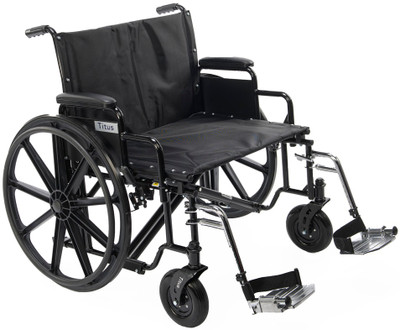
The Titus is the value pick if a 22- or 24-inch seat fits. Its steel frame and removable arm options suit shoppers who need a straightforward folding manual wheelchair. Compare the configured price if you need elevating legrests or a wider seat.
- 500 lb versions: 22- and 24-inch seats. The chairs measure 30 and 32 inches wide overall, respectively.
- 700 lb versions: 26-, 28- and 30-inch seats. Overall widths are 36, 38 and 40 inches, respectively.
- Chair weight: 56–64 lb without footrests across the full range.
Best extra-wide bariatric wheelchair: Drive Sentra EC Extra Wide
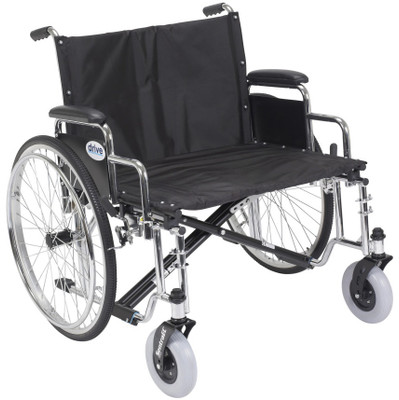
Consider the Extra Wide Sentra if you need a 26- to 30-inch seat and a 700 lb rating. Its overall width is one inch less than the Titus at each of those seat widths. The two chairs are worth comparing if you have a wide seat requirement and limited clearance.
- Capacity and seat: 700 lb, with a 20-inch depth across all three seat widths.
- Overall width: 35, 37 or 39 inches, respectively.
- Setup: Reinforced folding frame, removable padded arms and a choice of front rigging. Look for Extra Wide in the model name. ADHME lists the 20- to 24-inch Sentra EC Heavy-Duty separately at 450 lb.
Electric bariatric wheelchairs for 500 lb users
The Golden Compass HD in our catalog supports up to 450 lb. If you need a power wheelchair rated for a 500 lb user, one manufacturer-listed example is the Merits Atlantis P710, rated at 600 lb. Merits lists a 5 mph top speed, up to 32 miles per charge, 300 W motors and a joystick controller. It lists a total weight of 304 lb and a heaviest component of 167 lb. Confirm range under your expected conditions and plan for compatible vehicle loading equipment. Contact the manufacturer or a local power mobility dealer for configuration and availability.
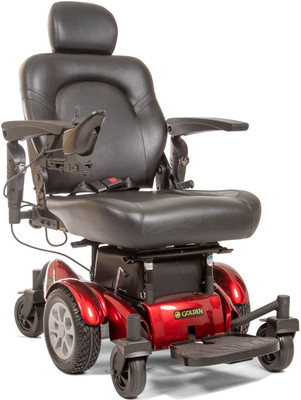
For users up to 450 lb: The Golden Compass HD has mid-wheel drive, a joystick and a listed 20-inch turning radius. Golden lists a top speed of 4 mph and a range of up to 12 miles. Compare your clear door openings and tightest turns against the dimensions of the selected configuration.
View the Golden Compass HDBest caregiver-pushed option for users up to 450 lb: ProBasics Bariatric Steel Transport Chair
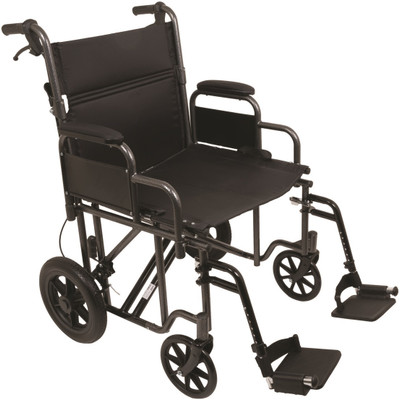
This model is designed for a caregiver to push. It has attendant hand brakes, 12-inch rear wheels and a folding back. The seat measures 22 by 18 inches, the chair is 28 inches wide overall, and it folds to 11 inches wide. It weighs 41 lb without footrests.
Need 500 lb capacity for a chair a caregiver can push? Consider a 500 lb manual chair with push handles, such as the Traveler HD, if the caregiver can safely manage the combined weight and intended route.
View the ProBasics transport chairManual, power or transport: Which works for your day?
Manual: Typically costs less and has fewer parts to maintain than a power wheelchair. Many fold for transport. Choose a manual model if you can propel it for your usual distances or if reliable pushing assistance is available. A wide seat or poor rear-wheel position can make the handrims harder to reach.
Power: Can provide independent mobility when manual propulsion is tiring or impractical. Check that the user can comfortably operate the controls. Plan for charging, battery service, turning room, vehicle transport and safe access over thresholds or ramps.
Transport: Suits outings where someone will be available to push, such as an appointment. Compare braking controls, chair weight and the terrain the caregiver will handle. Capacity still comes first.
How to measure for a bariatric wheelchair
- Measure the person while seated. With the person sitting in a comfortable, supported position and wearing typical clothing, measure across the widest part of the hips or thighs. Hold two flat objects lightly against the sides and measure the straight distance between them.
- Allow room for clothing and positioning. Use the body measurement as the starting point. Confirm the appropriate clearance with the manufacturer’s sizing guidance or a seating professional, especially if the person uses side supports or has a history of pressure injuries.
- Check seat depth and height. Measure from the back of the buttocks to the back of the knee and allow clearance behind the knee. Check the final seat height with the cushion in place against foot support and the surfaces the person transfers to, such as a bed or toilet.
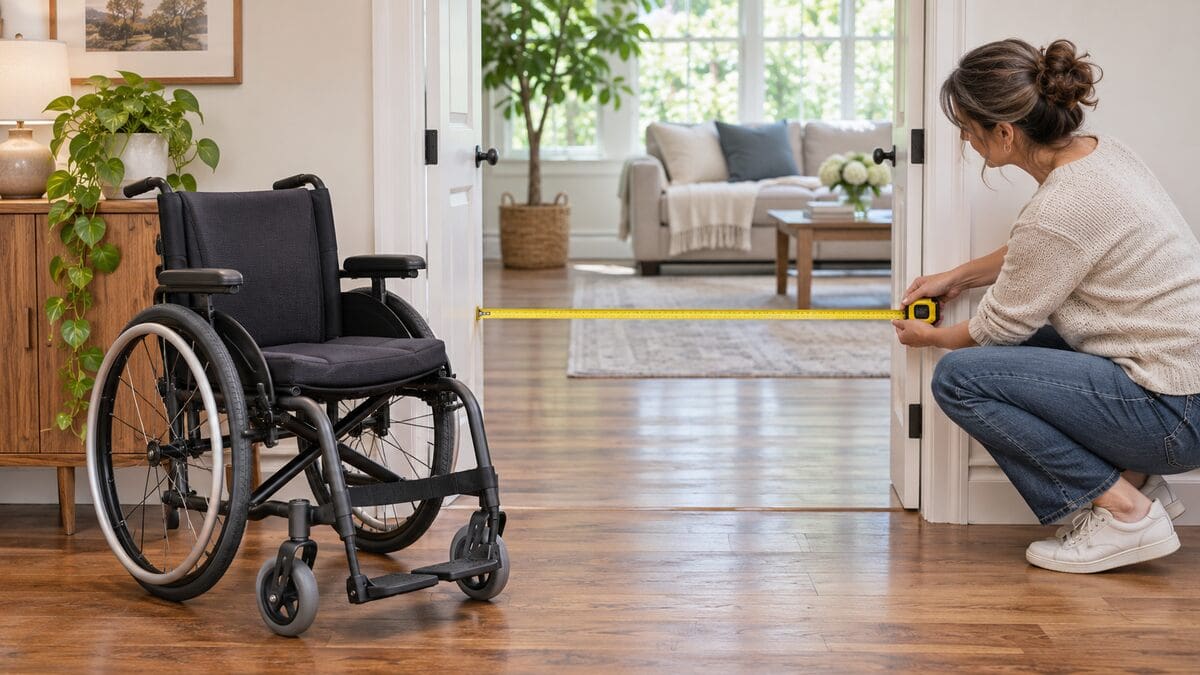
- Measure the actual route. With the door open to 90 degrees where possible, measure between the face of the open door and the opposite stop at the narrowest point. Check the turn into the room, as well as thresholds, hallway corners, elevator openings and any ramp or lift.
See the WHO wheelchair fitting reference manual and the U.S. Access Board’s guide to measuring clear door openings.
How wide a doorway does a bariatric wheelchair need?
Use the chair’s overall width with its selected options, plus room to steer and, when self-propelling, space for hands at the rims. A 32-inch clear opening is an accessibility benchmark for many doorways covered by the ADA Standards. A 32-inch-wide chair still needs maneuvering clearance, and a chair that fits straight through may need more room when the approach involves a turn.
How seat width changes overall width
Examples from our catalog
| Model | Seat width | Overall width |
|---|---|---|
| ProBasics steel transport TCS1916SV | 19 in. | 22 in. |
| ProBasics bariatric transport TCS221612SV | 22 in. | 28 in. |
| Traveler HD | 22 in. | 30.5 in. |
| Sentra EC Extra Wide | 30 in. | 39 in. |
| Proactive Titus | 30 in. | 40 in. |
When comparing listings, check whether the manufacturer’s width includes the handrims, armrests, joystick or other components that may protrude. For a lift or ramp, check both usable platform dimensions and the rated load for the combined chair, user and equipment.
What does a bariatric wheelchair cost?
For a sense of scale, our ProBasics 450 lb transport chair was listed around $255. Our 500 lb manual examples started around $335 for the Titus and $525 for the Traveler HD. The 700 lb Extra Wide Sentra started around $880. The Golden Compass HD, a 450 lb power chair, was listed around $5,325. These are examples from our catalog. The seat configuration, legrests, accessories and delivery requirements can change the total. For a 500 lb or higher power chair, get a quote for the configuration and service you need.
When does renting save money?
Renting can be practical for a short trip, temporary recovery or a trial. Ask for the total including delivery, pickup, minimum rental term and fees. Compare that with the purchase price for a chair of the same capacity and size. For example, a $100 delivery and pickup charge plus $75 per week comes to $400 after four weeks. If a suitable chair costs $400 to buy, that is the break-even point before taxes and other charges.
Can you finance a bariatric wheelchair?
American Discount Home Medical offers Bread Pay financing at checkout for eligible buyers. Review the APR, repayment term and total cost shown in your offer. See our payment and store policies.
What to check before ordering online
- Confirm the exact model and rating. Match the product listing to the manufacturer’s model number, manual and selected configuration. If they disagree, ask the seller to confirm the rating in writing. Reviews can help you assess handling and comfort.
- Ask who handles support. Find out who can verify measurements, obtain replacement parts and handle warranty claims. Compare the delivered price for the same model and options when using a price guarantee.
- Check shipping and returns before you pay. ADHME offers free ground shipping in the contiguous U.S. Ask how an oversized chair will be delivered. Our return policy generally allows 30 days on eligible products, with prior authorization, customer-paid return shipping and a 15–20% restocking fee. Some chairs are marked nonreturnable, so check the exact listing and full store policies before ordering.
Frequently asked questions
What is the widest bariatric wheelchair available?
Among the manual models featured here, the widest listed seat is 30 inches, available on both the Drive Sentra EC Extra Wide and Proactive Titus. The chairs measure 39 and 40 inches wide overall, respectively. Specialty seating can be configured beyond what is listed in a retail catalog. If you need more than 30 inches of seat width, work with a seating specialist and measure where the chair will be used.
Can a bariatric wheelchair hold 600 or 1,000 lb?
Yes, when that specific chair is rated for the load. The 700 lb Titus and Sentra configurations are manual options for a 600 lb user when the seat fits. The Merits Atlantis is an example of a 600 lb power model. For 1,000 lb, 21st Century Scientific lists a custom Big Bounder 1000 power wheelchair. Work with a specialty provider to confirm the configuration and the capacity of any lift, ramp or transport equipment.
Is buying a used bariatric wheelchair a good idea?
It can save money if you can verify the exact model, rating and fit. Have a qualified technician check the frame and cross braces for damage or repairs and inspect the wheel locks, wheels, casters, upholstery and footrest mounts. For power chairs, also check the batteries, charger and controls. Choose a new or professionally refurbished chair with documented specifications if you cannot verify the condition or capacity of a used one.
Find a bariatric wheelchair that fits you and your home
Start with the Traveler HD if you need a 500 lb rating and a 20- to 24-inch seat. Compare the Titus if price matters or you need a wider seat. If your doorway clearance is close, call us at 800-956-6616 with your seat measurement and narrowest clear opening. We can help you compare configurations before you order.
Shop Heavy-Duty Wheelchairs